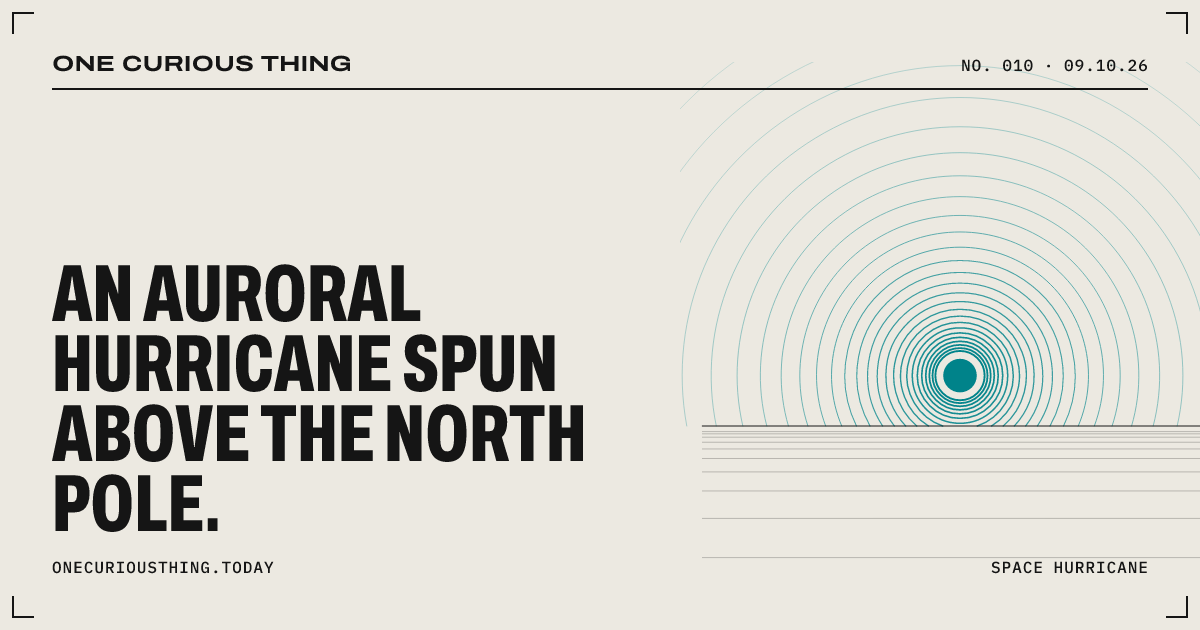
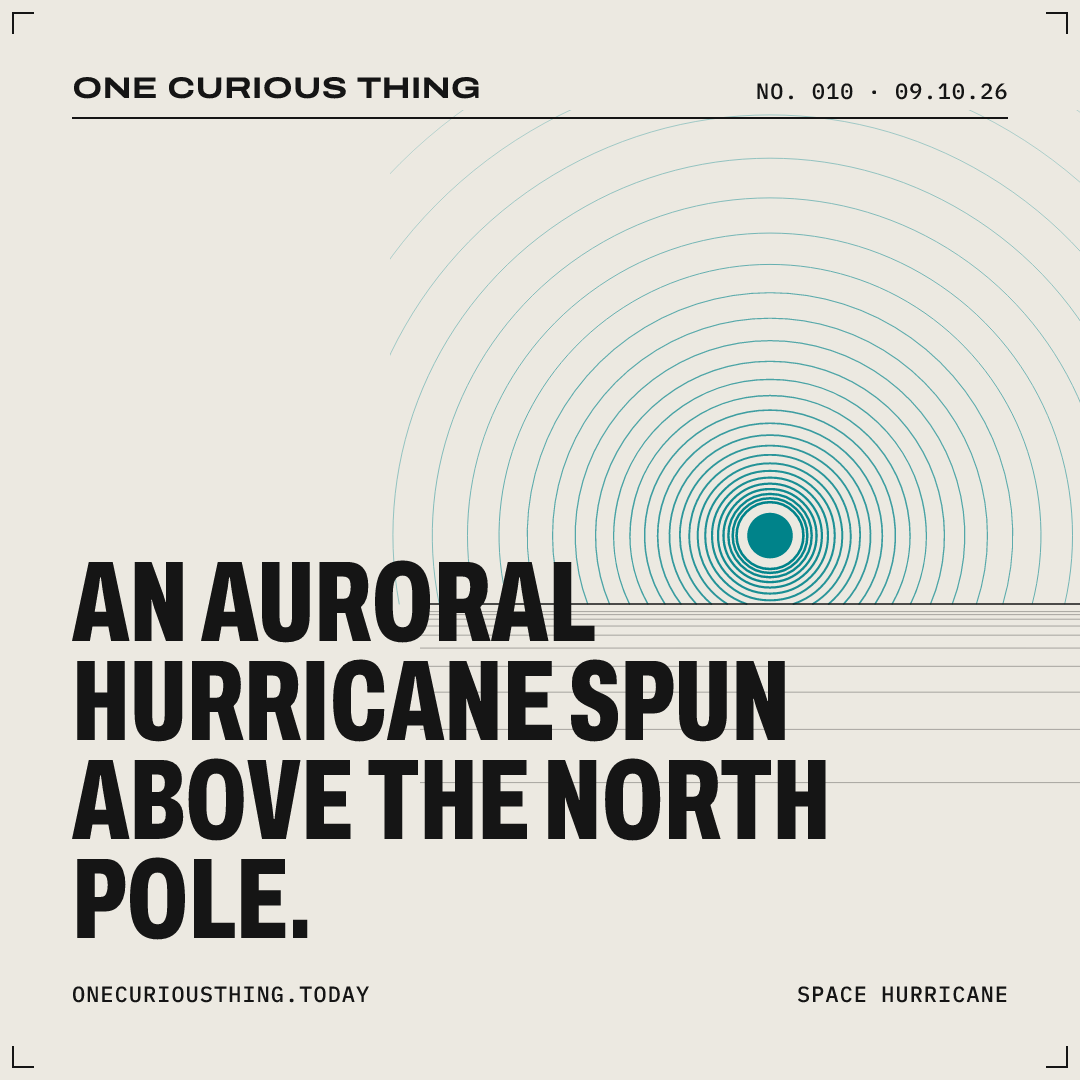
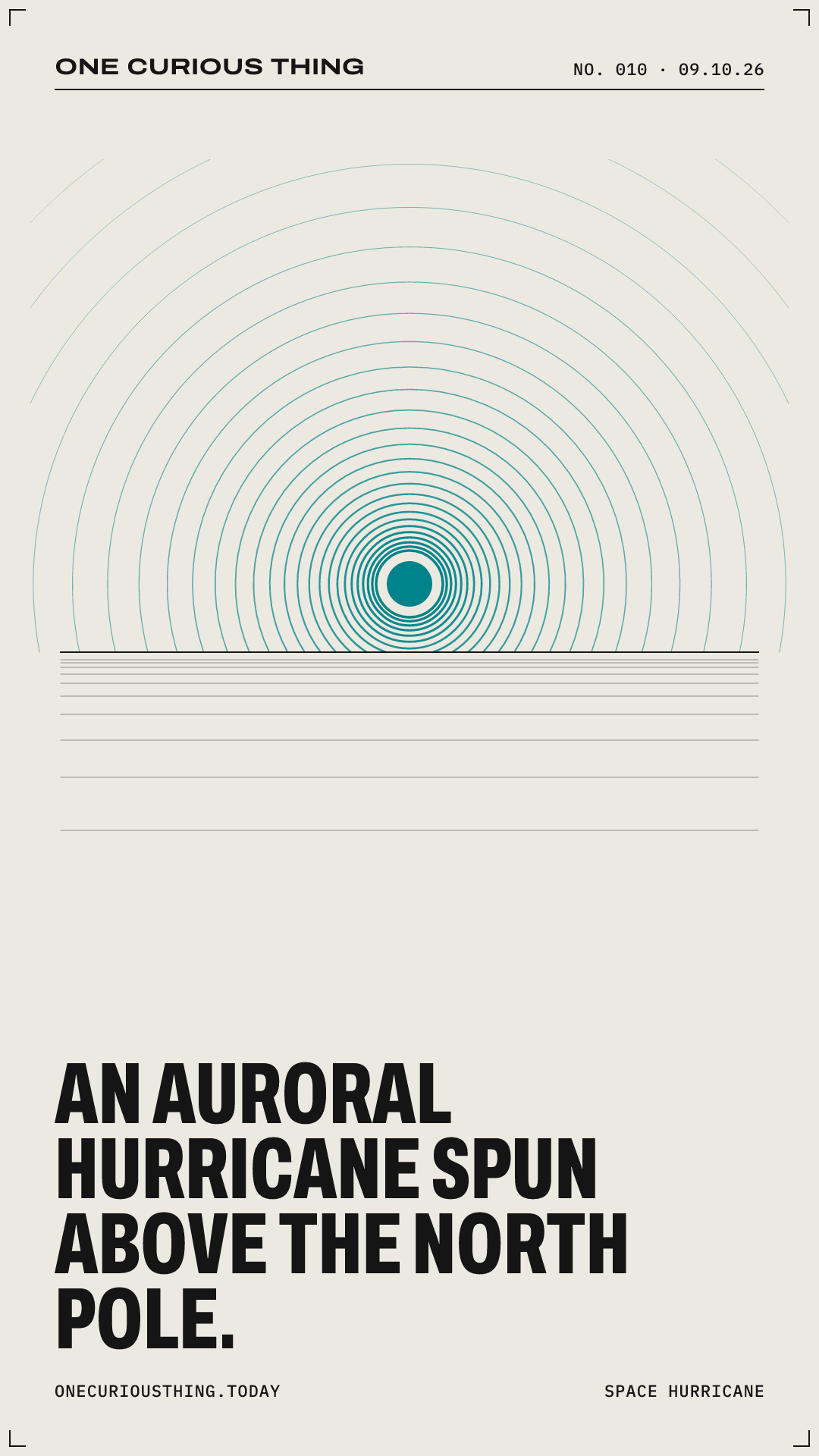
An auroral hurricane spun above the North Pole.

Space hurricane — Earth’s north polar ionosphere

Satellites later revealed that on 20 August 2014 a cyclone‑shaped aurora swirled above Earth’s north polar ionosphere for about eight hours. It spanned more than a thousand kilometers, with fast circular plasma flows around a nearly calm center, and intense electron “rain” lighting the vortex. Reported in 2021, this space hurricane shows that hurricane‑like energy pathways can form in near‑Earth space even during unusually quiet geomagnetic conditions.

Why it’s interesting

Fig. 010 Diameter of the cyclone‑shaped auroral vortex over the north polar ionosphere on 20 Aug 2014.
Why it’s interesting

Auroras aren’t only curtains and arcs—they can organize into long‑lived, hurricane‑like vortices. It suggests space weather can build orderly structures over the pole without the drama of a storm.

The longer version

On a quiet day for geomagnetic activity, satellites saw a cyclone‑like auroral spot parked over the north magnetic pole. Circular ionospheric plasma flows spun around a nearly motionless eye, while electrons accelerated to roughly 10 kilo‑electronvolts rained into the upper atmosphere, creating a luminous vortex more than 1,000 kilometers across. The structure persisted for about eight hours and faded when the interplanetary magnetic field shifted.

Researchers reconstructed the event using Defense Meteorological Satellite Program passes, AMPERE/Iridium maps of field‑aligned currents, and THEMIS measurements of upstream solar‑wind conditions. Their analysis, published in 2021 in Nature Communications, used the term “space hurricane” for this polar auroral vortex and showed that such features can arise without a major solar storm, expanding how we understand energy coupling under northward interplanetary magnetic fields.

Edition
No. 010
Date
Friday 9 October 2026
Subject
Space hurricane
Locality
Earth’s north polar ionosphere
Period
20 August 2014
Field
space
Evidence
4 sources, 1 primary

See how we got here

Found after 27 research paths · Selected from 12 candidates

  1. 01 Auroras Polar lights caused by charged particles.
  2. 02 Polar ionosphere Upper atmosphere above the magnetic pole.
  3. 03 Ionospheric flows Circular plasma motion with a calm eye detected.
  4. 04 Electron precipitation ~10 keV electrons “rained” into the ionosphere.
  5. 05 Space hurricane (2014) Cyclone‑shaped aurora >1,000 km for ~8 hours.
  6. → An auroral hurricane spun above the North Pole.

Sources

Nothing publishes without independent sources. How we verify →

  1. 1
    A space hurricane over the Earth’s polar ionosphere

    Nature Communications · 2021 · peer reviewed Primary

    All primary details: publication date (2021-02-22), event date (Aug 20, 2014), duration (~8 h), size (>1,000 km), electron precipitation (~10 keV), instruments (DMSP, AMPERE), and location (northern polar ionosphere).

    doi.org

  2. 2
    A Space Hurricane Spotted Above the Polar Cap (Eos magazine, June 2021)

    American Geophysical Union (AGU) · 2021 · scientific organization

    Confirms date (20 Aug 2014), approximate size (~965 km ≈ 1,000 km), and duration (~8 hours) of the event.

    eos.org

  3. 3
    Space hurricane: Researchers identify first observation above Earth’s upper atmosphere

    University of Reading · 2021 · university

    University press release noting satellites observed the phenomenon in Aug 2014 and that findings were published in Nature Communications.

    reading.ac.uk

  4. 4
    The first known space hurricane pours electron ‘rain’

    Nature · 2021 · journalism

    Independent summary confirming 2014 detection, description as a ‘space hurricane,’ and characterization as electron ‘rain.’

    nature.com

Take it with you SquareStoryWide Permanent link

THE DISPATCH / FROM ONE CURIOUS THING

CURIOSITY
IN YOUR INBOX.

Your dose of the unexpected, on your schedule.

One Curious Thing — one thing worth knowing, every day.

Enjoying these? Help keep the presses running.

Buy me a coffee Built By AndyBZ