One Curious Thing

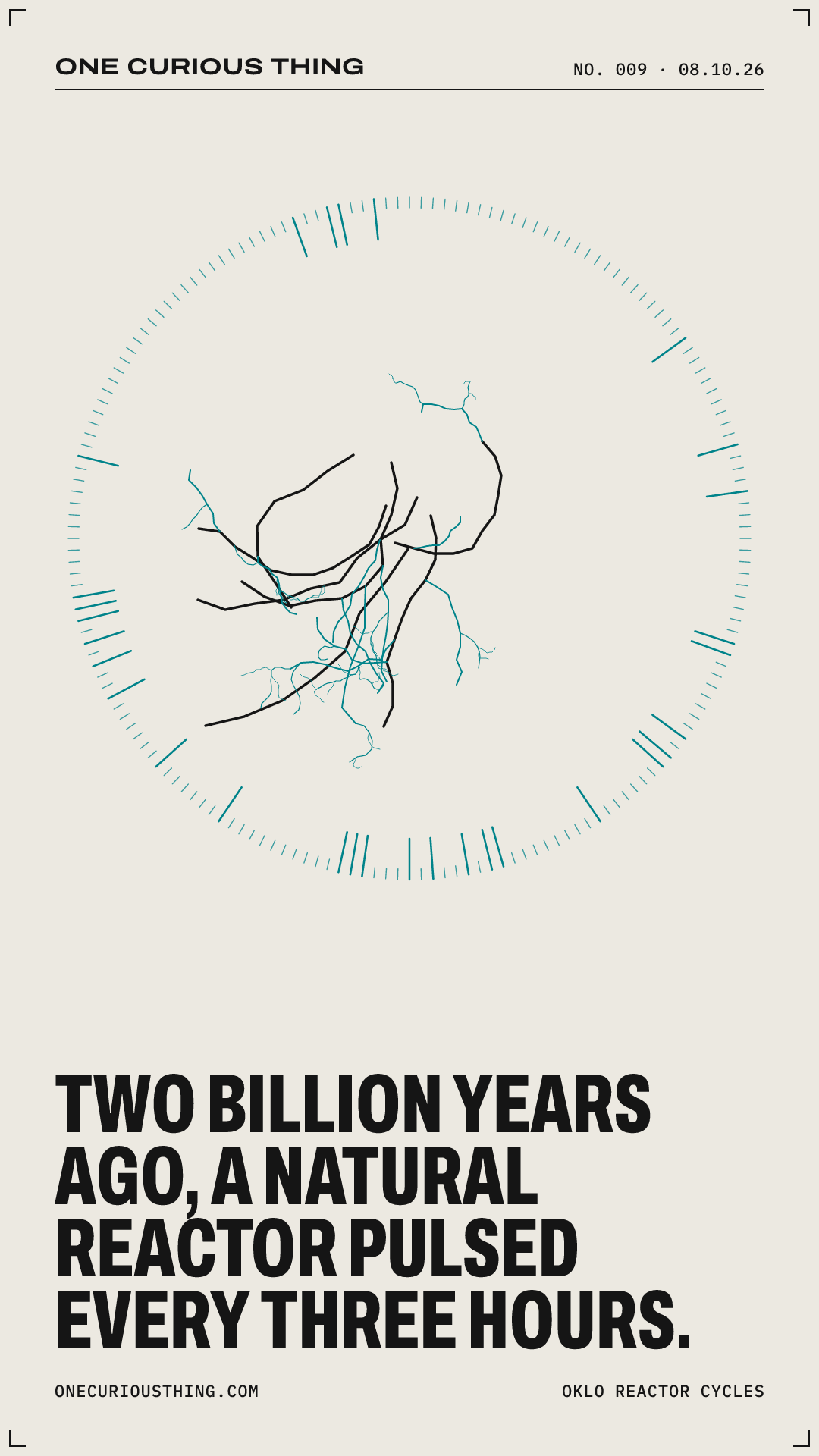
Two billion years ago, a natural reactor pulsed every three hours.

Oklo reactor cycles — Oklo, Gabon

Xenon gas trapped in tiny phosphate crystals near Oklo, Gabon, records a repeating pattern: about half an hour of fission followed by roughly two and a half hours of quiet. The cycle likely came from groundwater that slowed neutrons, then boiled away and later seeped back. It shows that Earth once ran a self‑regulating nuclear reactor without engineers, and that its rhythm can still be read today.

Why it’s interesting

Fig. 009 Active fission time within each three‑hour Oklo cycle, inferred from xenon records.
Why it’s interesting

It turns a reactor from a human invention into a geologic behavior with a steady beat. The clockwork survived in trapped gas, letting us time a machine that ran before animals existed.

The longer version

Oklo in Gabon hosts the only known natural nuclear reactors, which ran when a rich uranium ore body, wetted by groundwater, sustained a chain reaction. The effect was possible two billion years ago because uranium then contained a higher share of its easily fissioned form than it does today.

In 2004, researchers read the timing from xenon trapped in tiny uranium‑free phosphate grains formed around at least one Oklo reactor zone. The isotopic pattern resolves a cycle of roughly 30 minutes of operation followed by about 2.5 hours of shutdown, repeating. Later modeling reproduced this three‑hour rhythm and tied the control to groundwater that boiled off during power peaks and then seeped back to restart the reaction.

Edition
No. 009
Date
Thursday 8 October 2026
Subject
Oklo reactor cycles
Locality
Oklo, Gabon
Period
about 2 billion years ago
Field
physics
Evidence
4 sources, 1 primary

See how we got here

Found after 27 research paths · Selected from 12 candidates

  1. 01 Nuclear fission Splitting uranium releases energy and neutrons.
  2. 02 Natural reactors Ore bodies can go critical under the right conditions.
  3. 03 Oklo, Gabon Site of ancient self‑sustained fission.
  4. 04 Trapped xenon Gas in phosphate grains preserves on/off history.
  5. 05 Three‑hour pulses ~30 minutes on, ~2.5 hours off.
  6. → Two billion years ago, a natural reactor pulsed every three hours.

Sources

Nothing publishes without independent sources. How we verify →

  1. 1
    Record of Cycling Operation of the Natural Nuclear Reactor in the Oklo/Okelobondo Area in Gabon

    Physical Review Letters (APS) · 2004 · peer reviewed Primary

    Demonstrates xenon-isotope evidence for ~30 min on / 2.5 h off cycling; age ~2 billion years; sample context (U‑free aluminous hydroxy‑phosphate).

    doi.org

  2. 2
    Modeling the short-term and long-term behaviour of the Oklo natural nuclear reactor phenomenon

    Progress in Nuclear Energy (Elsevier) · 2020 · peer reviewed

    Peer‑reviewed modeling that reproduces the characteristic ~3‑hour cycle and describes self‑regulation by cyclic water/steam moderation; cites Meshik et al. (2004) for the ~30 min / 2.5 h timing.

    doi.org

  3. 3
    The Pulse of a Nuclear Reactor

    Physics (APS) – Phys. Rev. Focus · 2004 · journalism

    States that at least one Oklo reactor cycled every ~3 hours; explains groundwater moderation as the control mechanism; reiterates ~30 min on and ~2.5 h off.

    physics.aps.org

  4. 4
    Ancient nuclear power controlled by water

    Nature News · 2004 · journalism

    Reports 30‑minute active periods followed by ~2.5‑hour dormant spells; attributes self‑regulation to water boiling off and later reinfiltrating; Oklo discovery and context.

    nature.com

Take it with you SquareStoryWide Permanent link