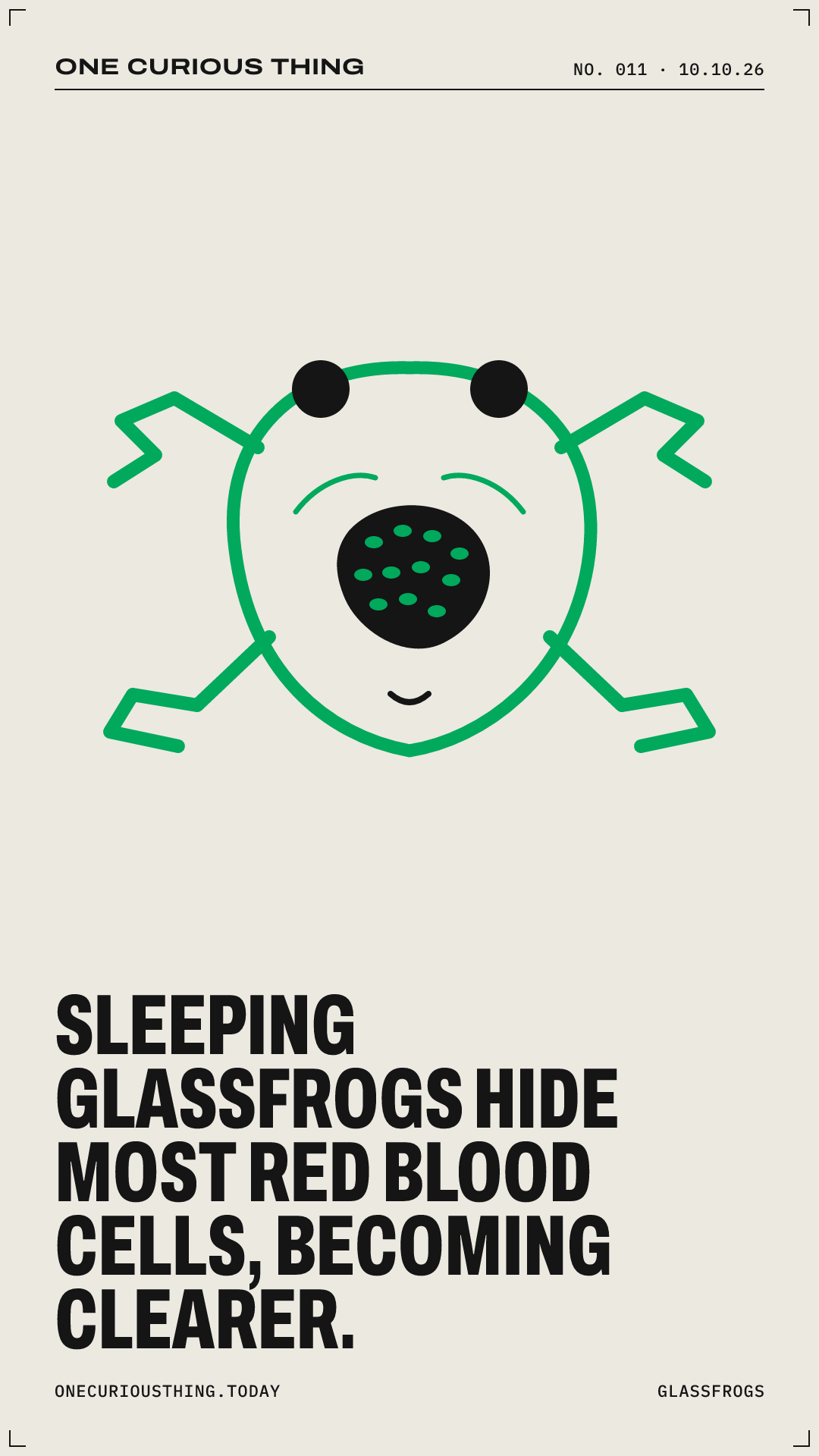
Sleeping glassfrogs hide most red blood cells, becoming clearer.

Glassfrogs

When northern glassfrogs (Hyalinobatrachium fleischmanni) go to sleep, they remove roughly 89% of their red blood cells from circulation and store them in the liver. With far fewer light‑absorbing cells in their tissues, their bodies become two to three times clearer. Remarkably, they pack and unpack this blood each day without triggering clots, a feat revealed in live frogs using photoacoustic imaging and confirmed by calibrated transparency measurements.

Why it’s interesting

Fig. 011 A glassfrog outline reveals a dark liver where blood cells gather during sleep.
Why it’s interesting

A vertebrate can park nearly all of its red blood cells for hours without clotting. It resets what “normal” circulation can look like when survival calls for transparency.

The longer version

On leaves by day, glassfrogs already look partly see‑through, but red blood still gives them away. Researchers found that as these frogs sleep, they sequester the vast majority of their red blood cells in the liver, reducing visible absorption and making the animals markedly clearer.

The team used in vivo photoacoustic microscopy to track hemoglobin inside awake and sleeping frogs. Across individuals, 82–93% of red blood cells moved into the liver during sleep, and optical measurements showed transparency increased two‑ to threefold. The frogs reversed this daily without signs of clotting or blocked vessels, all documented in a peer‑reviewed Science study.

Edition
No. 011
Date
Saturday 10 October 2026
Subject
Glassfrogs
Period
2022
Field
life
Evidence
3 sources, 1 primary

See how we got here

Found after 23 research paths · Selected from 12 candidates

  1. 01 Camouflage Hiding in plain sight sometimes means transparency.
  2. 02 Transparency in animals Works best in water; rare on land.
  3. 03 Glassfrogs Underbellies are see‑through; red blood spoils the effect.
  4. 04 Blood and color Hemoglobin strongly absorbs visible light.
  5. 05 Photoacoustic microscopy Tracks red blood cells in living tissue.
  6. 06 Liver sequestration Sleeping frogs store ~89% of red cells in the liver.
  7. → Sleeping glassfrogs hide most red blood cells, becoming clearer.

Sources

Nothing publishes without independent sources. How we verify →

  1. 1
    Glassfrogs conceal blood in their liver to maintain transparency

    Science (rehosted PDF via Science Friday) · 2022 · peer reviewed Primary

    Primary evidence for RBC sequestration (~82–93%, avg ~89%) in liver during sleep; two‑ to threefold transparency increase; no clotting; in vivo photoacoustic imaging; species H. fleischmanni; publication details.

    sciencefriday.com

  2. 2
    Transparent glassfrogs 'vanish' at night by hiding red blood cells in liver

    Live Science · 2022 · journalism

    Reports nearly 90% of RBCs removed from circulation and stored in the liver; explains photoacoustic microscopy; notes absence of clotting.

    livescience.com

  3. 3
    Sleeping glass frogs hide by storing most of their blood in their liver

    Science News · 2022 · journalism

    Corroborates that roughly 90% of RBCs are sequestered in the liver during sleep, transparency can double or triple, and the effect is observed without blood clots; mentions photoacoustic imaging as the enabling technique.

    sciencenews.org

Take it with you Challenge a friend ↗ SquareStoryWide Permanent link

THE DISPATCH / FROM ONE CURIOUS THING

CURIOSITY
IN YOUR INBOX.

Your dose of the unexpected, on your schedule.

One Curious Thing — one thing worth knowing, every day.

Enjoying these? Help keep the presses running.

Buy me a coffee Built By AndyBZ