One Curious Thing

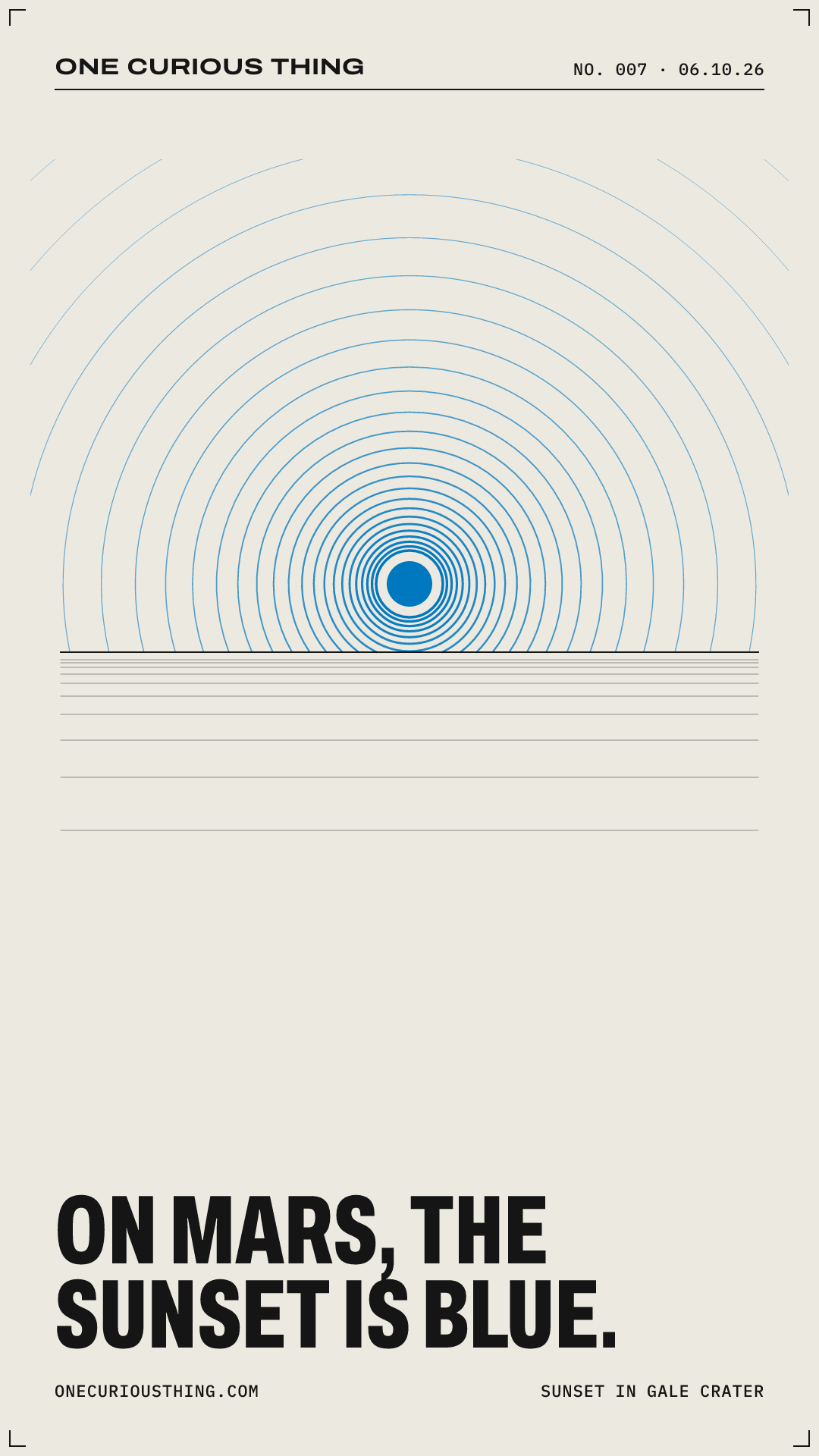
On Mars, the sunset is blue.

Sunset in Gale Crater — Gale Crater, Mars

On 15 April 2015, NASA’s Curiosity rover photographed the Sun going down over Gale Crater, and the sky around it glowed blue. Fine dust in the Martian atmosphere lets blue light through more efficiently than redder light, so the blue stays close to the Sun while warmer colours are scattered more widely across the sky.

Why it’s interesting

Fig. 007 Scattered light, tightening around its source as the Sun meets the horizon.
Why it’s interesting

We read sunsets as warm. The same physics, acting on different particles, inverts the palette — the colour of a sunset belongs to the air, not the Sun.

The longer version

The images were taken by Curiosity’s Mastcam camera at the end of the mission’s 956th Martian day. NASA notes the camera sees colour much as human eyes do — and is actually a little less sensitive to blue than people are. A person standing there would see a blue sunset at least as clearly.

Edition
No. 007
Date
Tuesday 6 October 2026
Subject
Sunset in Gale Crater
Locality
Gale Crater, Mars
Period
Sol 956 · 15 April 2015
Field
space
Evidence
2 sources, 1 primary

See how we got here

Selected from 21 candidates

  1. 01 Planetary atmospheres
  2. 02 Light scattering
  3. 03 Martian dust
  4. 04 Curiosity Mastcam
  5. 05 Sol 956
  6. → On Mars, the sunset is blue.

Sources

Nothing publishes without independent sources. How we verify →

  1. 1
    Sunset in Mars’ Gale Crater (PIA19400)

    NASA Jet Propulsion Laboratory · 2015 · government Primary

    Image, date, and the dust-scattering explanation.

    jpl.nasa.gov

  2. 2
    Sunset in Mars’ Gale Crater

    NASA Science · government

    Mastcam colour sensitivity relative to human eyes.

    science.nasa.gov

Take it with you SquareStoryWide Permanent link